The Origin of Q-Codes in Amateur Radio
Q-codes did not originally come from amateur radio itself, but from early telegraph and Morse code communication.
The Development of Q-Codes
Q-codes were introduced in the early 20th century by the International Telecommunication Union (ITU). Their purpose was to simplify international radio and telegraph communication.
At that time, communication was carried out almost entirely using Morse code, and language barriers were a major challenge. To solve this problem, standardized short codes were created that could be understood regardless of language.
Each Q-code:
- begins with the letter “Q”
- is followed by two additional letters
- has a fixed meaning
Why the Letter “Q”?
The letter “Q” was chosen because it is easy to recognize in Morse code and allows for many possible combinations. In addition, the letter was not heavily used in the international radio alphabet at the time.
Q-Codes in Amateur Radio
Originally, Q-codes covered many technical and operational topics, such as weather conditions, frequencies, and signal reception.
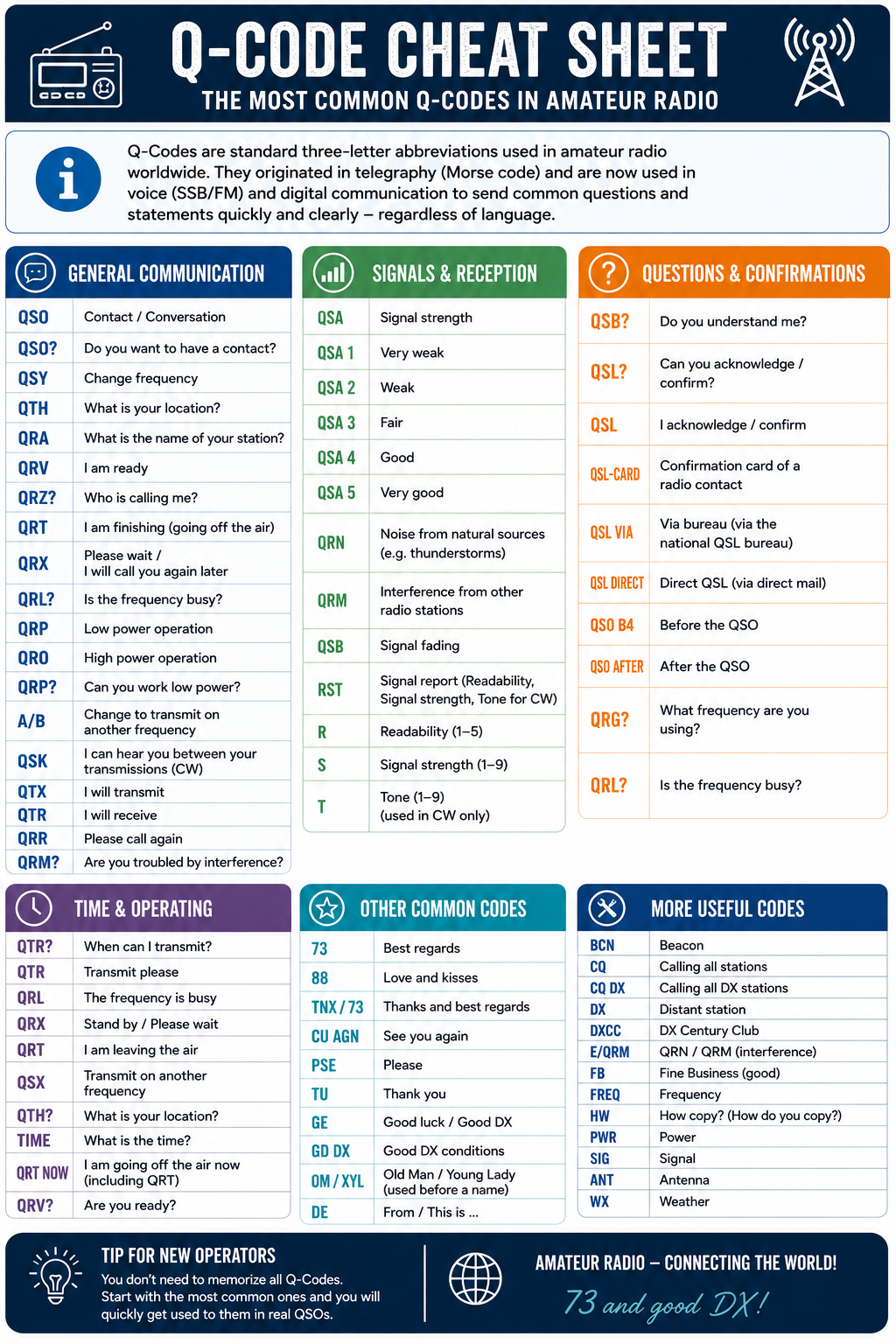
In amateur radio, however, only a smaller number of Q-codes became widely established and are still commonly used today, for example:
- QTH – location or station position
- QSO – a radio contact
- QRV – ready for operation
- QRM – interference from other stations
- QSL – confirmation of a contact
Many other Q-codes are rarely used today or are mainly found in professional radio communication services.